This month's PCPro mentioned VirtualDub and suggested it had good facilities for stop motion.
VirtualDub is a video capture/processing utility for 32-bit and 64-bit Windows platforms (98/ME/NT4/2000/XP/Vista/7), licensed under the GNU General Public License (GPL). It lacks the editing power of a general-purpose editor such as Adobe Premiere, but is streamlined for fast linear operations over video. It has batch-processing capabilities for processing large numbers of files and can be extended with third-party video filters. VirtualDub is mainly geared toward processing AVI files, although it can read (not write) MPEG-1 and also handle sets of BMP images.
Here's a quick video to explain how you would use it.
The other evening I was lucky enough to attend a Q&A session with David Sproxton, Nick Park and Peter Lord from Aardman talking to David Rowan from Wired at the Apple Store in Covent Garden.
David Sproxton mentioned that their two new films were in 3D, one CGI and the other stop motion. This got me wondering about what were the technical issues of trying to create stereo stop motion.
The Wired article on Aardman mentions a little, such as that you end up with twice as many pictures to store, that you need to have "rigs for the cameras" and there are post production issues.
I guessed at one of the issues which is that if you were to use two cameras they would need to be very close together. The solution is to use a single camera and a rig to shuffle it along before taking a second picture, these are called "Stereoscopic Stepper Rigs"
Editing of stereo video is straightforward and there are several choices for editing software. You are obviously going to need more storage and more processing power as there is more for the editing software to do. Many people edit in 2D and then the software handles the editing of the 3D.
Post production issues are the usual ones for stop motion such as colour balance. However there is also the alignment of the two images, typical corrections include horizontal and vertical offsets, zoom discrepancies, keystone, and rotation.
Other 3D stop motion films
There was Coraline, the first stop-motion animated feature to be shot entirely in stereoscopic 3-D.
Foxed! by the Geneva Film Co is also in production.
Frank Passingham: one of the few highly regarded cinematographers in the field of animated film who has the knowledge and experience of producing 3D stop-frame animated feature films. He was a DOP on Chicken Run and is currently a DOP on the new Aardman feature Pirates.
Tom Barnes: Technical Director of the new Aardman feature film Pirates.
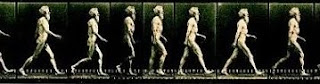
Most animators will know Muybridge from his books, Animals in Motion or The Human Figure in Motion. He is famous for his use of clever photography that used multiple cameras in quick succession to produce the characteristic images of horses walking and running.
This exhibition at Tate Britain provides a more overall view of his work. The first few rooms of the exhibit look at Muybridge's time in California and Central America. Whilst there Muybridge experimented with a range of photographic techniques. In Yosemite he produced very large prints and attempted to use multiple exposures, a technique we now called "High Dynamic Range" photography. He also successfully grafted the sky from one photo onto the landscape of another. Stereo photographs were another of his achivements but the examples and glasses provided at the Tate don't demonstrate this effect as well as I've seen elsewhere.
The panoramas of San Francisco are very impressive and as well as showing photographic achivement show the social history via the items and buildings.
The second half of the exhibit focuses on the photos of moving animals and people we more commonly associate with Muybridge.
His early work focuses on horses and in some cases the photographs were of such poor quality that he employed artists to trace the outlines. However these were sufficient for basic analysis of foot movements and show the arcs that animators should be used to seeing. As well as moving pictures of horses Muybridge took still images to aid an artist with foreshortening. As he got more practiced at taking photographs of movement he also developped more advanced and faster camera shutters. His topics also grew in sophistication with acrobats, and athletes employed as models. His photographs of everyday people including himself in the nude cause controversy. However not all were critical with artists such as Edgar Degas for one taking inspiration for his leaping horse sculpture.
So that people could see these photographs in action, Muybridge invented the Zoopraxiscope which was effectively a projector version of the Phenakistiscope.
The Zoopraxiscope used a disc of tiny 15mm slides with a counter rotating disc of slots to project the moving images. This is one of the earliest examples of projected motion picures.
The Muybridge exhibition is at the Tate until 16th Jan 2011 and gives a great insight into the works of this pioneering photograph and aid to all animators.
Sintel is the latest release from the Blender Foundation. They've come a long way since 2005 when I watched the Elephants Dream, the first film from the foundation. The plot of the film has received some critisim but I felt it held together well and was quite watchable something I did not feel was the situation with the Elephant's Dream.
The technical challenges the team have taken on for this film are numerous, massive landscapes, snow, sand, fire, humans and animals are all done very proficiently. There were a couple of times I though the camera movement was not very natural but the photography was also very good.
All in all a very watchable short film and I wish the film all the best in the up comming festivals that it's showing at.
Wall framing and Door
-
The roof tiling for the new Workshop was completed last month and had
proven to work well in both hot and rainy weather. I then took a break from
buildin...